
Digital marketing has become an important part of how businesses connect with people, build visibility, and grow in an increasingly digital world. From search engines and social media to websites, online advertising, and content, digital platforms have changed the way brands communicate with their audiences.
For me, digital marketing is more than simply learning different online tools. It is a field that combines creativity, technology, communication, research, and continuous learning. My journey in this field is about understanding these different areas, developing practical skills, and gradually building myself as a digital marketing professional.
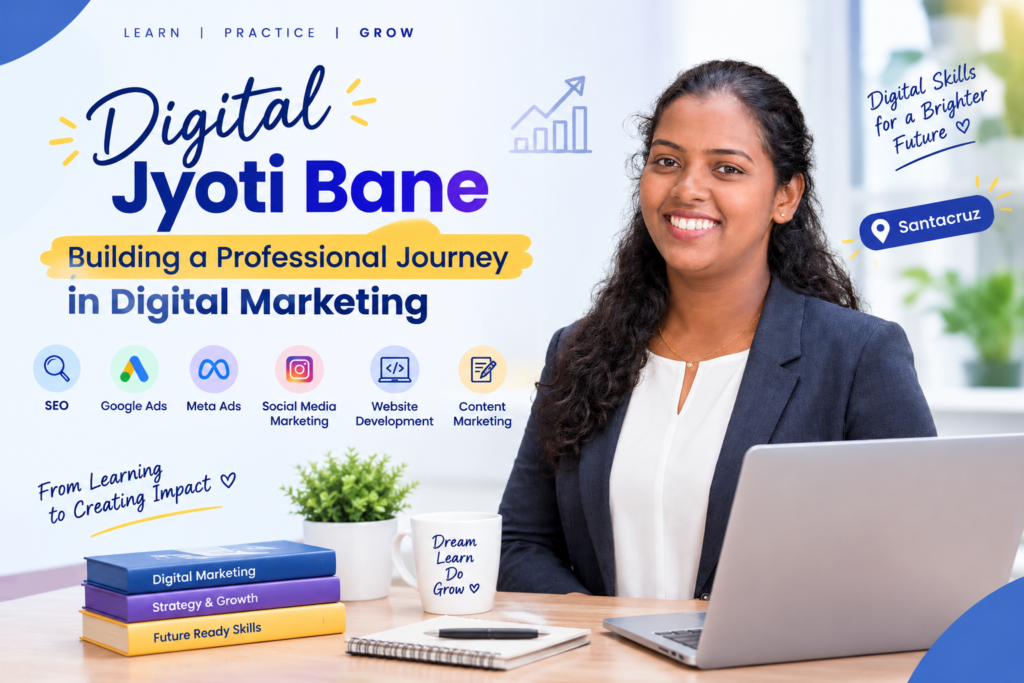
I am Digital Jyoti Bane, based in Santacruz, Mumbai, and I am building my professional journey in digital marketing with a focus on practical learning and continuous improvement. I am certified by DGmark Institute, where I have been developing my understanding of different areas of digital marketing.
My journey is still developing, and that is something I value. Instead of presenting myself as someone who has already reached the end of the journey, I see myself as a professional who is continuously learning, experimenting, improving, and preparing for the opportunities ahead.
Who Is Digital Jyoti Bane?
Digital Jyoti Bane represents my professional identity and my journey into the world of digital marketing.
My interest in digital marketing developed from understanding how strongly businesses and individuals now depend on their online presence. A website, social media profile, search visibility, online advertisement, or useful piece of content can influence how people discover and interact with a brand.
What attracted me to this field was the combination of different skills involved. Digital marketing is not limited to one activity. It brings together areas such as SEO, social media marketing, paid advertising, content marketing, website development, analytics, and online branding.
As I started learning these areas, I realized that every part of digital marketing connects with another.
For example, a website needs good content and SEO to become more visible in search. Social media can help a brand communicate with its audience, while paid advertising can help reach specific groups of people. Content can build awareness and trust, while analytics can help understand whether a strategy is working.
This interconnected nature of digital marketing is one of the reasons I continue to explore the field.
Being based in Santacruz, Mumbai, also gives me an interest in the opportunities available to local businesses and professionals. Many small businesses have good products or services but may still need to improve how they present themselves online. Understanding digital marketing can help me learn how businesses can approach these challenges more strategically.
Why I Chose Digital Marketing
Choosing a career path is not always about having every answer from the beginning. Sometimes, it starts with curiosity and the willingness to explore something new.
For me, digital marketing became interesting because it is a field where learning never really stops.
The digital environment keeps changing. Search engines update their systems, social media platforms introduce new features, advertising platforms evolve, consumer behaviour changes, and new technologies continue to influence marketing.
That means a digital marketer needs to keep learning.
I also like the balance between creative and analytical thinking. Creating content requires creativity, while understanding campaign performance requires analysis. Writing an article requires communication skills, while SEO requires research and strategic thinking. Designing a social media campaign can involve creativity, while measuring its performance requires data.
This combination makes digital marketing an exciting field to learn.
Another reason I chose digital marketing is the opportunity to understand how businesses can build their online presence. A strong digital presence is not created by simply posting regularly or running advertisements. It requires an understanding of the business, its audience, its goals, and the platforms where potential customers spend their time.
Learning these connections has changed the way I look at online marketing.
My Learning Journey in Digital Marketing
My approach to learning digital marketing is based on understanding the fundamentals first and then trying to connect those concepts with practical applications.
There is a difference between knowing the definition of SEO and understanding how SEO works in practice.
Similarly, knowing what Meta Ads are is different from understanding campaign objectives, audiences, creatives, budgets, performance metrics, and optimization.
This is why I believe practical learning is an important part of becoming a digital marketing professional.
During my learning journey, I have been exploring areas including:
- Search Engine Optimization
- Local SEO
- Google Ads
- Meta Ads
- Social Media Marketing
- Content Marketing
- Website Development
- Digital Marketing Strategy
- Online Branding
- Digital Analytics
Each area introduces a different way of thinking.
SEO teaches the importance of search intent, content quality, website structure, and visibility. Paid advertising introduces concepts such as targeting, campaign objectives, ad creatives, and performance measurement. Social media marketing focuses heavily on communication and audience engagement.
Website development adds another important dimension because a website is often the foundation of a brand’s online presence.
Learning all these areas together has helped me understand that digital marketing is not a collection of isolated skills. It is a connected system where different activities can support a common business objective.
Becoming a Certified Digital Marketer in Santacruz
As part of my professional development, I completed my digital marketing learning with DGmark Institute and became certified by the institute.
My certification is an important part of my learning journey because it represents structured education and the effort I have put into developing my understanding of digital marketing.
Being a certified digital marketer in Santacruz is not something I see as the final destination. Instead, I see certification as one step in a much longer professional journey.
A certificate can demonstrate that someone has completed a structured learning process, but professional growth also comes from applying knowledge, gaining practical exposure, learning from mistakes, and staying updated.
That is the approach I want to follow.
I want to continue developing my skills rather than simply collecting certifications. My goal is to understand why a particular digital marketing strategy works, when it should be used, how it can be improved, and how its performance can be measured.
This practical mindset is an important part of how I am building my professional identity.
What I Am Learning About SEO
Search Engine Optimization, commonly known as SEO, is one of the areas that interests me because it focuses on helping websites become more discoverable through search engines.
SEO involves much more than adding keywords to a webpage.
While learning SEO, I am developing an understanding of areas such as keyword research, on-page optimization, content structure, technical SEO basics, internal linking, website usability, and search intent.
One of the most important things I have learned is that SEO should ultimately focus on people.
A webpage may target an important keyword, but if the content does not answer the visitor’s question or provide a useful experience, simply ranking for a keyword does not create much value.
This has helped me understand the importance of balancing search engine requirements with human readers.
For example, when creating content, I need to think about what someone is actually searching for, what information they need, and how clearly that information can be presented.
SEO is therefore not just about visibility. It is also about relevance, usefulness, structure, and user experience.
Exploring Local SEO
Local SEO is another area that is particularly interesting to me because it connects digital marketing with local businesses and communities.
For a local business, being visible when people search for products or services in a particular area can be valuable.
A business operating in Mumbai, for example, may want to reach people searching for its services within specific neighbourhoods or areas.
Local SEO can involve optimizing a business’s online information, website content, local signals, and other digital touchpoints to improve local visibility.
As someone building my professional identity in Santacruz, learning about local SEO also helps me understand how location-based businesses can approach digital marketing.
It shows how digital strategies can be adapted according to the actual needs of a business rather than using the same approach for everyone.
Learning Google Ads and Meta Ads
Paid advertising is another important part of my digital marketing learning journey.
Google Ads and Meta Ads provide businesses with opportunities to reach specific audiences, but successful advertising involves more than simply creating an advertisement.
It requires understanding the campaign objective, audience, messaging, creative, budget, landing page, and performance data.
While learning paid advertising, I am developing an understanding of how these different elements work together.
For example, an advertisement may receive attention, but that does not automatically mean the campaign has achieved its business objective. Depending on the campaign, marketers may need to consider metrics such as clicks, leads, conversions, cost, engagement, or return on advertising spend.
This is where the analytical side of digital marketing becomes important.
Learning to look beyond surface-level numbers is something I want to continue developing throughout my career.
Continuing the Journey
My digital marketing journey is still being built one skill at a time.
From SEO and Local SEO to paid advertising, social media, content, and websites, every new area gives me another opportunity to understand how digital marketing works as a complete system.
Being certified by DGmark Institute has given me a structured foundation, but I believe the next stage is about continuing to practice, experiment, learn, and improve.
For me, becoming a professional digital marketer is not about reaching a point where there is nothing left to learn. It is about developing the mindset to keep learning as the industry changes.
This is only one part of my journey, and there is much more I want to explore.
Developing My Skills Through Practical Learning
Learning digital marketing has taught me that understanding a concept is only the beginning. The real learning starts when you try to apply that concept to an actual situation.
This is why I want my professional development to be based on practical learning rather than only theoretical knowledge.
When I learn about SEO, for example, I want to understand how keyword research connects with content creation, website structure, search intent, and user experience. When I learn about advertising, I want to understand how different campaign objectives influence the way an advertisement is created and measured.
This approach has helped me look at digital marketing as a process rather than a collection of individual tools.
A typical digital marketing process can be thought of as:
Understand → Research → Plan → Implement → Measure → Improve
Each step has a purpose.
Understand the Business
Before developing any digital strategy, it is important to understand what the business actually wants to achieve.
The objective could be increasing awareness, generating leads, improving website traffic, promoting a product, increasing enquiries, or building a stronger online presence.
Without understanding the business objective, it becomes difficult to determine which digital marketing activities should receive attention.
Research the Industry and Audience
Research is another important part of digital marketing.
A marketer needs to understand the industry, competitors, customers, search behaviour, communication preferences, and problems that the audience may be trying to solve.
Audience research can influence everything from keywords and content topics to advertising messages and social media communication.
Plan the Strategy
Once the business and audience are understood, the next step is planning.
A strategy can include SEO, content marketing, social media, paid advertising, website improvements, Local SEO, or a combination of different channels.
The important point is that the strategy should connect back to the business objective.
Implement the Plan
A strategy only becomes meaningful when it is implemented.
This can involve creating content, optimizing webpages, preparing advertisements, managing social media content, improving website pages, or setting up tracking.
Implementation also creates an opportunity to discover what works in practice and what needs improvement.
Measure Performance
Digital marketing provides access to a wide range of data.
Traffic, clicks, engagement, leads, conversions, cost, and other metrics can help marketers understand campaign and content performance.
However, numbers should always be considered in context.
A high number of website visitors may look positive, but if those visitors are not relevant to the business, the traffic may not contribute significantly to the actual goal.
Improve Continuously
The final stage is optimization.
Digital marketing is rarely a process where something is created once and then left unchanged.
Content can be improved. Campaigns can be optimized. Audiences can be refined. Website pages can be tested. SEO strategies can be updated.
This continuous improvement mindset is something I want to carry throughout my career.
Exploring Social Media Marketing
Social media has become an important part of how people discover, follow, and communicate with brands.
For me, learning social media marketing is not simply about understanding how to create a post.
It involves understanding what a particular audience wants to see, how a brand should communicate, what type of content is useful, and how consistency contributes to building an online presence.
Different content formats can serve different purposes.
For example, short-form videos can attract attention, educational carousels can explain concepts, stories can create regular interaction, and longer-form content can provide deeper information.
The challenge is to create content that is not only visible but also meaningful.
I am particularly interested in the relationship between content and personal branding.
As I build my own professional identity as Digital Jyoti Bane, creating useful content can help me document what I am learning while also developing my communication skills.
Instead of trying to appear as someone who knows everything, I believe there is value in sharing a genuine learning journey.
My Approach to Content Marketing
Content marketing is another area that I find interesting because it combines research, creativity, communication, and SEO.
Good content should have a purpose.
It might answer a question, solve a problem, explain a concept, introduce an idea, or help someone make a more informed decision.
For businesses, content can also help establish communication with potential customers before they are ready to make a purchase.
A blog article, for example, can answer a question that a potential customer is searching for. A social media post can explain a common problem. A video can demonstrate how something works. A guide can help someone understand a complicated topic.
This has influenced the way I think about creating content.
Instead of asking only, “What should I post?”, I try to think about questions such as:
- Who am I creating this content for?
- What problem does it address?
- What information does the audience need?
- What action should the reader take next?
- Can the information be explained more clearly?
- Is the content genuinely useful?
These questions can help turn content creation from a routine activity into a strategic part of digital marketing.
Learning Website Development
A website is another area that has become an important part of my learning journey.
I am interested in website development because a website can act as the central point of a brand’s online presence.
Social media profiles, advertisements, search traffic, and content can all direct people toward a website.
That means the website needs to provide a good experience once someone arrives.
While learning website development, I am becoming more aware of elements such as:
- Website structure
- Navigation
- Mobile responsiveness
- Page speed
- Calls to action
- Content organization
- Visual hierarchy
- SEO-friendly structure
- User experience
A professional-looking website should not only look attractive. It should also make it easy for visitors to understand who the business is, what it offers, why it matters, and what they should do next.
This is where website development and digital marketing come together.
Building My Personal Brand
Building a personal brand has become an important part of my professional journey.
For me, personal branding is not about trying to create a perfect image.
It is about creating a consistent professional identity and allowing people to understand what I am learning, what skills I am developing, and what I am interested in.
My website is an important part of this process.
It provides a space where I can present my skills, write about digital marketing topics, share my learning journey, and gradually build a professional portfolio.
LinkedIn and other social platforms can complement this by allowing me to communicate and connect with people interested in digital marketing.
Blogging is also valuable because it gives me an opportunity to explore topics in greater depth.
When I write about a topic, I need to research it, organize my thoughts, explain the subject clearly, and consider what a reader would find useful.
In that way, content creation itself becomes a learning exercise.
Why I Want to Share My Learning Journey
There are many people who are interested in digital marketing but are unsure where to start.
Students may wonder which skills to learn first. Beginners may feel overwhelmed by the number of tools available. People changing careers may wonder whether digital marketing is the right direction for them.
I understand that learning a new field can sometimes feel confusing.
That is one reason I want my online presence to reflect my actual journey.
I do not want to present digital marketing as something that can be mastered overnight.
There are different skills to understand, platforms to explore, strategies to test, and concepts to practice.
Progress can take time.
By documenting my own journey, I hope to create content that is useful to other learners while also holding myself accountable for continuing to learn.
Challenges I Am Learning From
Every learning journey has challenges.
Digital marketing can initially seem overwhelming because there are so many areas to understand.
SEO has its own concepts. Paid advertising has different platforms and campaign structures. Social media requires creativity and consistency. Analytics requires attention to data. Website development introduces technical considerations.
Trying to understand everything at once can be difficult.
One of the lessons I am learning is that progress does not require knowing everything immediately.
Instead, I can focus on one area at a time.
I can understand the fundamentals, practice them, identify what I do not understand, research further, and then move forward.
This approach makes learning more manageable.
Another challenge is staying updated.
Digital marketing changes frequently, which means something that works today may need to be reconsidered tomorrow.
Rather than seeing this as a problem, I am learning to view it as part of the profession.
A good digital marketer needs curiosity and adaptability.
The Importance of Communication Skills
Digital marketing is often described as a technical field, but communication is equally important.
A marketer may understand SEO or advertising, but they also need to explain ideas clearly.
Communication is important when writing website content, preparing advertisements, creating social media posts, speaking with clients, presenting strategies, or explaining campaign performance.
This is an area I want to continue improving alongside my technical skills.
I believe professional growth involves both.
Technical knowledge helps a marketer understand what to do, while communication helps them explain why it should be done.
Using AI and Digital Tools Responsibly
Technology and artificial intelligence are becoming increasingly relevant to digital marketing.
AI tools can support marketers with research, brainstorming, content planning, analysis, and productivity.
However, I believe tools should support human thinking rather than completely replace it.
A marketer still needs to understand the audience, verify information, think critically, and make decisions based on the actual business situation.
For me, learning digital marketing also means learning how to use modern tools responsibly.
The goal is not simply to use the newest tool.
The goal is to understand whether a tool actually improves the quality, efficiency, or effectiveness of the work.
My Vision for Professional Growth
My long-term goal is to continue building a strong foundation in digital marketing and gradually develop deeper practical expertise.
I want to become more confident in areas such as SEO, Local SEO, Google Ads, Meta Ads, social media marketing, content marketing, website development, and analytics.
At the same time, I want to continue developing the professional qualities that are important in any career:
- Communication
- Creativity
- Problem-solving
- Research
- Analytical thinking
- Adaptability
- Consistency
- Curiosity
- Professional discipline
I believe these qualities can be just as important as knowing how to use a particular digital marketing platform.
What I Want to Learn Next
There is still a lot I want to explore.
As I continue developing my skills, I want to gain a deeper understanding of performance marketing, advanced SEO, analytics, conversion optimization, paid advertising, content strategy, and digital strategy.
I also want to gain more practical exposure.
Working on real projects can provide lessons that cannot always be learned through theory alone.
It can reveal how different businesses have different audiences, challenges, budgets, goals, and expectations.
That practical understanding is something I want to develop gradually.
Building a Career, One Skill at a Time
My professional journey in digital marketing is not about reaching a destination as quickly as possible.
It is about building a strong foundation.
Every new skill adds another part to that foundation.
Learning SEO helps me understand search visibility. Learning advertising helps me understand paid customer acquisition. Learning social media helps me understand digital communication. Learning content marketing helps me understand how useful information can attract and engage an audience. Learning website development helps me understand the importance of digital experiences.
Together, these skills are shaping the professional identity I am building as Digital Jyoti Bane.
Being a certified digital marketer in Santacruz is one part of that identity, supported by my certification from DGmark Institute. But my journey does not end with certification.
The next stage is about practice, experience, experimentation, and continuous learning.
Looking Ahead
The digital marketing industry continues to create opportunities for people who are willing to learn and adapt.
My goal is to approach those opportunities with an open mind.
I want to continue improving my skills, building practical experience, creating useful content, and developing a professional online presence.
I also want to remain honest about where I am in my journey.
I am learning. I am practicing. I am building.
And I believe that this process itself is an important part of becoming a professional.
Digital Jyoti Bane is therefore more than just a name on a website or social media profile. It represents a professional journey that is being built through learning, curiosity, practical skill development, and a commitment to continuous growth.
There is still much more to learn, but every step adds something valuable.
The journey is still beginning, and I am looking forward to where it leads.